
How Landed Cost Allocation Works for Ocean Freight, Tariffs, and Customs Duties
Ask a purchasing buyer what an imported stainless valve casting costs, and they will read the supplier purchase order price: $42.00 per unit. Ask the controller six weeks later after the ocean carrier bill, marine insurance, port drayage, customs brokerage fee, and tariff surcharge clear Accounts Payable, and the real cost sitting on the shelf is closer to $51.40. When an ERP cannot bridge that timing gap cleanly, sales reps price quotes off fictional margins while finance buries thousands of dollars of freight and duty in a generic expense account.
Core Takeaway
Booking imported materials at factory-gate purchase price overstates unit gross margin and dumps freight and tariffs into unallocated overhead. Three-stage clearing accruals and containerized landed cost vouchers push actual freight, insurance, and duty straight into receipt cost layers.
Why factory-gate receiving prices break item margins
Physical goods and freight invoices never arrive on the same Tuesday.
Your receiving dock unloads a forty-foot container on the third of the month so production can start machining parts that afternoon. At that moment, the warehouse has the physical goods and the supplier commercial invoice, while the ocean forwarder bill and customs broker entry summary are still two or three weeks away.
Teams running basic ERP setups usually fall into one of two traps. Either they hold purchase receipts open until every broker bill arrives, starving the shop floor of available stock, or they receive items at bare supplier price and code later freight and tariff invoices to a lump-sum Cost of Goods Sold (COGS) variance account. Heavy, bulky items that soaked up half the container space look artificially profitable, while small high-value electronics sitting in the same box subsidize them.
If ocean freight and tariff surcharges sit in a lump-sum expense account, your best-selling imported SKU might quietly lose money on every shipment.
Three-stage clearing accruals and multi-method voucher allocation
Accurate landed costing separates physical dock availability from final carrier billing without losing the accounting link.
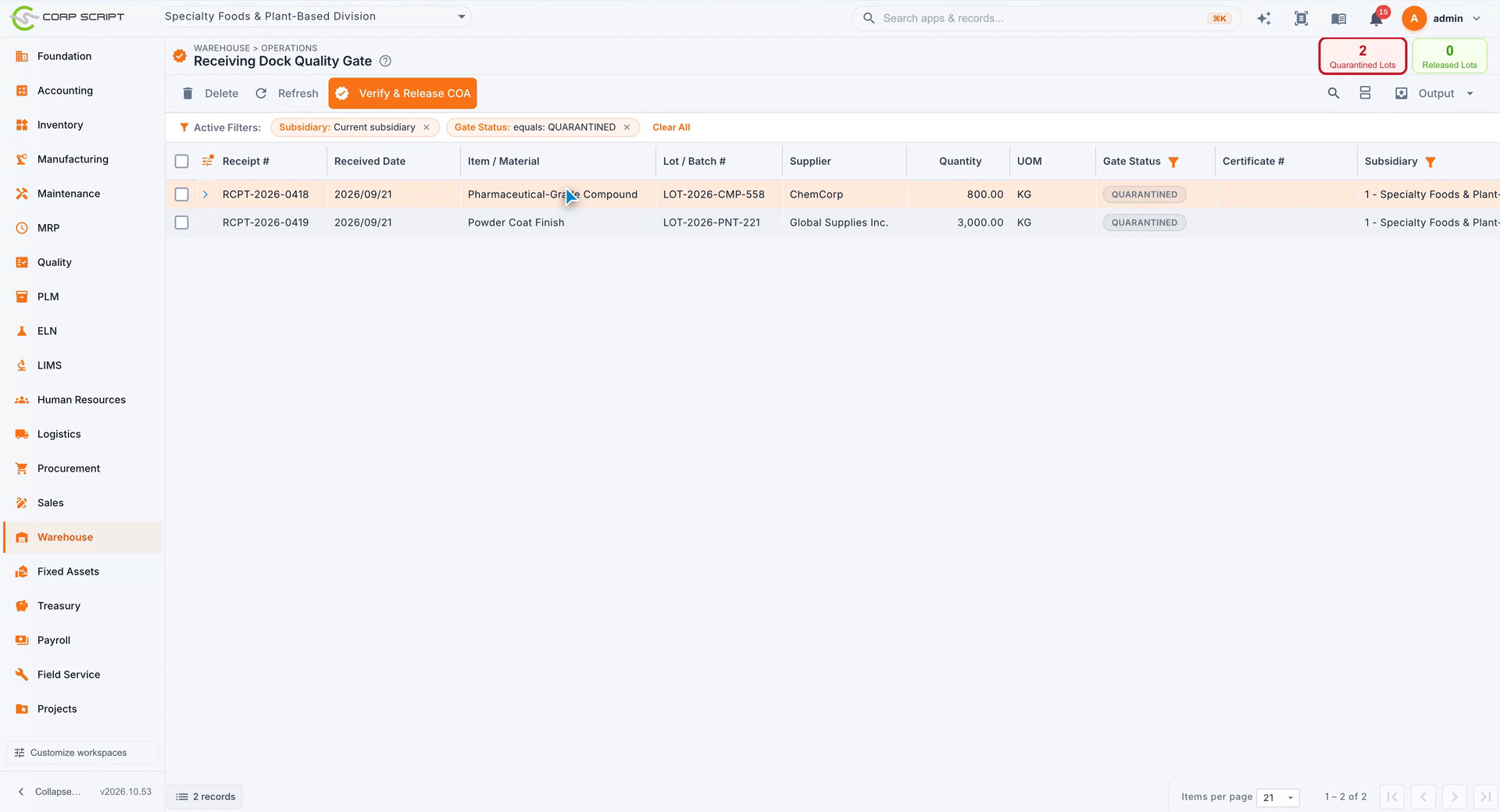
At Purchase Receipt, CorpScript captures three-stage clearing accruals across Goods Received Not Invoiced, estimated freight accrual, and customs duty clearing. Stock becomes available to quality gates or shop work orders right away, while clearing accounts hold the expected liability on the balance sheet.
When forwarder and customs broker invoices arrive, accounting links them on a containerized Landed Cost voucher with an automatically assigned document number. Instead of forcing one blunt percentage across a mixed container, each charge line can allocate across receipt items by physical weight, cubic volume, unit quantity, or purchase value. Ocean drayage can split by cubic volume, heavy steel handling by weight, and ad valorem customs tariffs by declared line value. Purchasing and cost accounting see the exact per-unit impact on screen before posting a single cent to inventory.
Container landed cost rollup in CorpScript
- 1Inbound dock receiptReceiving
Logs lots and posts three-stage freight and duty accruals.
- 2Broker & carrier billsAccounts Payable
Freight, insurance, and tariff bills book against clearing accounts.
- 3Landed cost voucherCost Accounting
Splits charges by weight, cubic volume, quantity, or value.
- 4Layer revaluationInventory
Adjusts receipt cost layers and Cost of Goods Sold directly.
- 5Re-run or unwindController
Replaces draft lines cleanly or unwinds posted layers atomically.
Updating inventory valuation layers and handling late broker revisions
Calculating the split is only half the job. Those dollars have to reach the exact inventory valuation layers that feed work orders and customer shipments.
When a Landed Cost voucher posts in CorpScript, cost adjustments roll straight into the linked receipt inventory layers. Units still sitting in warehouse bins carry their true landed unit value, and units already issued to manufacturing work orders or shipped to customers follow through to Cost of Goods Sold so item profitability reports reconcile with the General Ledger. Commercial teams quoting repeat orders see real landed costs rather than outdated overseas factory prices, which prevents sales reps from giving away margin when container rates or tariff schedules jump.
Import paperwork also changes in real life when a customs broker amends a tariff classification or a carrier sends a detention surcharge. Re-allocating a draft Landed Cost voucher replaces prior draft lines cleanly without leaving duplicate adjustments behind. Should a tariff rate change retroactively or a broker bill get matched to the wrong container, finance never has to hunt through dozens of manual journal lines to repair item costs. If a posted landed cost run needs to be corrected, an atomic allocation reversal unwinds both the inventory layer revaluations and the General Ledger journals in a single balanced transaction.
| Cost Question | Lump-Sum Overhead | CorpScript Landed Cost |
|---|---|---|
| Stock receipt value | Bare supplier FOB price | Three-stage goods, freight, and duty accruals |
| Mixed-container split | Flat percentage guess | Weight, cubic volume, quantity, or value |
| Broker amendments | Disconnected manual journal | Clean draft re-run or atomic GL unwind |
| Unit margin accuracy | Bulky SKUs overstated | True landed cost on layers and COGS |
Controller & Buyer Margin Check
When tariffs rise on an imported product family, do item cost layers update from customs entries or sit in a lump-sum freight account?
Bypassing receipt layers leaves sales quoting understated costs until after period close.
Related Product Walkthrough · Manufacturing & Ops
Keeping Online Channels and Third Party Warehouses Matched Across Entities
Keep multi-brand inventory, online storefronts, third-party warehouses, and Canadian dollar (CAD) and United States dollar (USD) entities matched in one ERP without silent stock overwrites. Global Catalog Products, Shopify and Amazon Stock Keeping Unit (SKU) crosswalks, blind cycle counts, in-transit-adjusted Third-Party Logistics (3PL) variance queues, cross-border landed costs, consolidation eliminations, and pre-cutover SKU cleanup stay tied directly to the General Ledger (GL).
Common questions
- Can we mix different allocation methods on the same imported container?
- Yes. A single Landed Cost voucher can allocate ocean freight by cubic volume, port handling by weight, inspection fees by unit quantity, and customs tariffs by declared line value across the same Purchase Receipt.
- What happens when a customs broker bill arrives after we already received the goods?
- Three-stage clearing accruals let the dock receive stock immediately while holding freight and duty clearing balances open. Once final carrier and broker bills arrive, posting the Landed Cost voucher clears the accrual and updates the receipt valuation layers.
- How do you fix a Landed Cost voucher if a tariff code or freight bill was entered wrong?
- Draft vouchers can be re-allocated as many times as needed, cleanly replacing earlier draft lines. For already posted vouchers, CorpScript executes an atomic reversal that unwinds both the inventory layer cost adjustments and the General Ledger entries together.